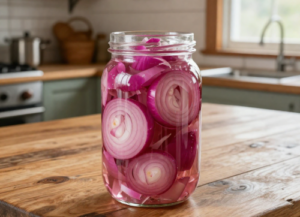
Onions were one of the earliest cultivated crops because they were less perishable, transportable, easy to grow and could be grown in a variety of soils and climates. In addition, because onions have a high water content, they help prevent thirst and could be dried and preserved for later use when food might be scarce. All varieties of onions probably originated in the same areas in central and south Asia. Onion bulbs come in red, yellow and white. There are also shallots and scallions with smaller bulbs. Of large bulb onions, the red onion has the most nutritional value because of its red pigments. Their purple color is named “red” due to their tendency to turn red when pickled. And red onions have the best consistency for pickling. Historically, pickled onions have been the primary method of preservation. Today, you find them in British pubs, in Indian cooking, and on Central and South American tables among many cultures around the world. All onions are good sources of in dietary fiber, vitamins, minerals and phytonutrients, but red onions have superior antioxidant power.
Peak Time: April to July in the south but available year round
Average Price: $0.99 each
Tips for Selection and Storage: Red onions are wrapped in red-purple thin, papery, parchment-like skin that is delicate and easily flakes off when touched. Underneath the skin, there is a burgundy wine-colored translucent film that protects the flesh, and the dark purple flesh is firm, crisp and coarse with many layers of white and purple rings. Red onions are crunchy, sweet and slightly spicy when raw and when cooked their flavor lessens and grows mildly sweeter. Look for medium size onions that have no bruises, cuts, mold or sprouting. To store, wrap in paper towels and hang in pantyhose tied between each onion in a cool dry place. You can also store these individually wrapped in a single layer in the refrigerator or in another cool dry place in your house. These can last for months.
Tips for Preparation: Allow sliced or chopped red onions to sit for about 10 minutes before cooking to maximize their micronutrient content and enzyme activity. Because some antioxidants can be reduced by high heat, eating raw red onions — such as in salads, salsas or as a garnish, delivers the highest bioavailability of certain phytonutrients. Red onions are best suited for both raw and cooked applications such as grilling, roasting, braising, caramelizing, and are most commonly used for pickling. Pickled red onions are used on tacos, chopped and tossed into fresh salads, placed on hot dogs, sprinkled on top of a pizza, served with grilled fish, or made into a jam to use as a condiment.
Nutritional Highlights: Like all onions, red onions are good sources of vitamin C, biotin, vitamin B6, manganese and chromium with fair amounts of phosphorus, copper, potassium, thiamin and folate. However, red onions are the onion family phytonutrient superstar. Their dark red pigments contain anthocyanins, quercetin and organosulfur compounds, which provide powerful antioxidant, anti-inflammatory and immune-boosting effects in the body.